Quinlan Forrest / April 5, 2026 / MC0 427
What tools can we use to counter misinformation? This is a question that many people are asking. Some of the most effective tools I have discovered including RumorGuard and the game titled Get Bad News. In this post I will be showing and documenting how these tools work. I will even include a video showing Get Bad News, which I personally find to be a very fun game.
Rumor Guard
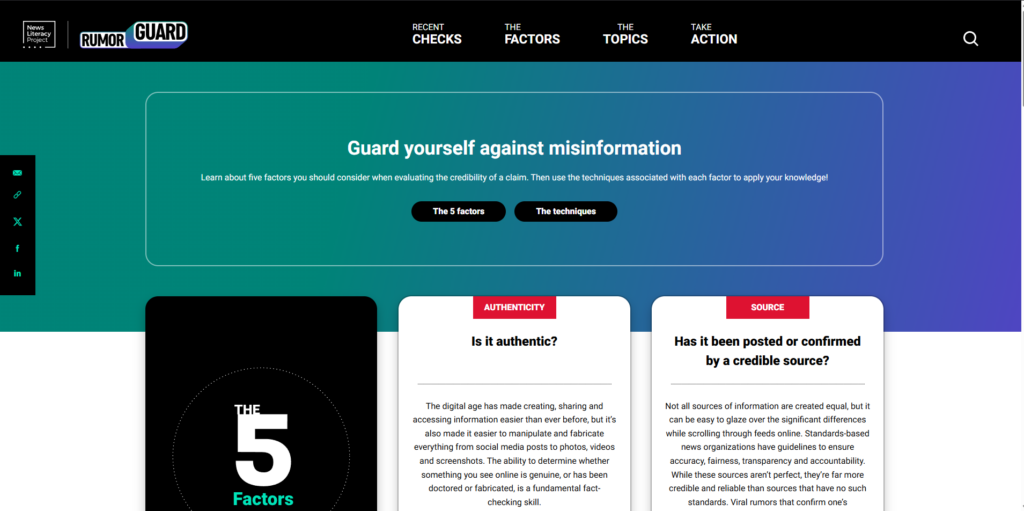
The National Literacy Project created RumorGuard in 2022 to help people learn how to spot disinformation. The website offers lessons, quizzes, and tutorials. The site was designed in a way that is accessible to people of all ages.
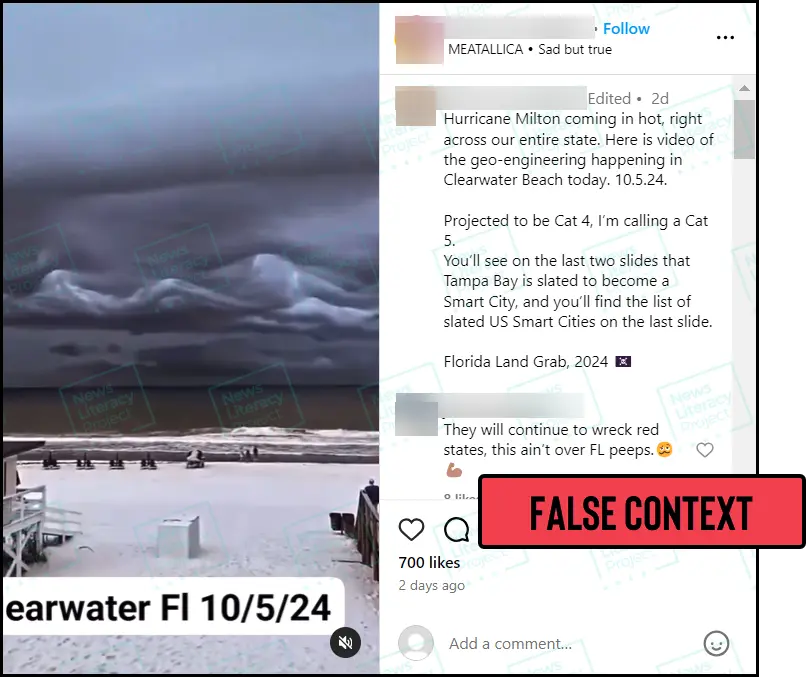
RumorGuard contains techniques for spotting misinformation, as well as giving readers examples of disinformation that has occurred online. My favorite article they wrote discussed claims circulating online that Hurricane Milton was “geoengineered” by the government for some reason.
The article tells us that the picture, which is a still photo of a video (seen below), wasn’t even filmed during Hurricane Milton. In actuality, it was filmed in 2021—three years before the hurricane occurred. It also didn’t depict a hurricane but instead showed asperitas cloud formations—which are rare but entirely natural.
Geoengineering is real and is a way to manipulate the environment to manage and mitigate the effects of climate change. However, there is no evidence geoengineering has been used for nefarious purposes. Partly because geoengineering is still largely conceptual and implemented on a small scale at this time.
According to RearGuard, we should use five different factors for determining disinformation. These factors include authenticity, sources, evidence, context, and reasoning. Here is what they say:
Authenticity (Is it genuine?)
Description: Misinformation often includes doctored or fabricated images and videos.
Strategy: Use reverse image websites, like Google Images or TinEye, to determine if the image matches the time and date of the original post. You can also use tools like FotoForensic to determine if a photo has been altered.
Source (Is it credible?)
Description: Misinformation often comes from unknown or unreliable sources.
Strategy: Investigate the “About Us” section of a website. Find out who runs the website and determine if they have credibility. Verify if an outlet is reputable using the Ad Fontes Media chart.
Evidence (Is it supported by facts?)
Description: Misinformation and disinformation are often distorted and outdated evidence.
Strategy: Look for direct links to documents, records, or scholarly papers. Research who the author is and determine their background. Try to determine if a claim can be backed up with multiple sources.
Context (Is the context accurate?)
Description: One of the most common forms of misinformation is called “false context.” Often, pictures in posts containing misinformation may be real and unaltered; however, the context surrounding them is incorrect.
Strategy: To determine the original date of an image or video, utilize reverse image searching or employ a program like MediaInfo to examine the metadata, which may include the creation date of the video. However, be aware that metadata can be modified.
Reasoning (Is it based on sound logic?)
Description: Misinformation often relies on flawed reasoning, logical fallacies, or appeals to emotion.
Strategy: Ask yourself if a claim is reasonable or logical. Take, for example, the conspiracy that the Moon landing was fake. It’s preposterous to think that a program that involved more than 400,000 engineers, physicists, technicians, and contractors was fake and that no one who worked on the Apollo program ever spoke out.
Bad News
Bad News is an interactive game that teaches us about fake news and disinformation from the perspective of a “disinformation tycoon.” This game was personally my favorite tool for learning because it kinda let me pretend to be evil.
Note: The claim that Trump threatened Canada